22 Oct 2026 · Kemicale Technical Team
Designing a fermentation medium: carbon and nitrogen sources
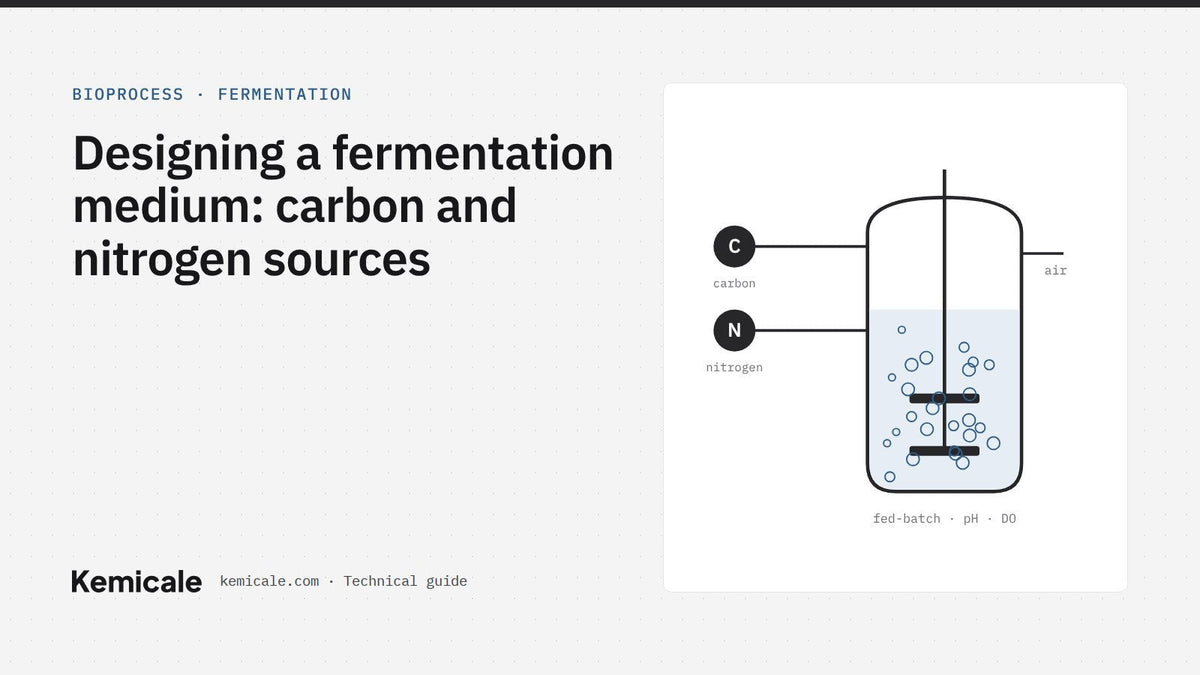
Every fermentation medium answers two questions: what will the cells eat for energy and carbon, and where will they get their nitrogen? The answers drive growth rate, by-product formation and, ultimately, titre.
Carbon sources
Carbon usually makes up the largest share of a medium by mass and cost. The common choices behave quite differently:
| Carbon source | Strengths | Watch out for |
|---|---|---|
| Dextrose (D-glucose), anhydrous | Fastest uptake by most organisms; inexpensive; well-characterised | Catabolite repression; overflow metabolism (acetate in E. coli, ethanol in yeast) at high feed rates |
| Glycerol | Slower uptake, often less acetate; the standard carbon source for Pichia growth phases | Lower maximum growth rate; viscous to dose |
| Sucrose | Cheap disaccharide for organisms with invertase | Not used by many lab E. coli strains |
| Maltose | Inducer and carbon source for some fungal and Bacillus systems | Uptake varies widely by strain |
| Lactose monohydrate | Induces the lac operon; basis of autoinduction media | Repressed while glucose is present |
Nitrogen sources
Nitrogen comes in two forms:
- Inorganic, mainly Ammonium sulphate and ammonium hydroxide (which doubles as the pH-control base). Defined, cheap and consistent, but it gives cells only nitrogen.
- Complex organic, such as Yeast extract powder and Soya peptone. These supply amino acids, peptides, vitamins and trace nutrients. They speed up growth and often lift product yields, at the cost of lot-to-lot variation.
Many processes combine both: a complex source in the batch medium to get the culture going, then a defined feed of carbon and ammonia during the fed-batch phase.
Balance the C:N ratio and the phosphate
A high carbon-to-nitrogen ratio favours storage products and secondary metabolites. A lower ratio favours biomass and protein. Phosphate salts such as Potassium phosphate, dibasic provide phosphorus and buffering capacity, but at high concentration they precipitate with magnesium and trace metals, so add those from separate stocks.
Defined vs complex media
Defined media make scale-up and regulatory filing easier because every component is known. Complex media are faster to develop and usually give higher early titres. A practical route is to start complex, find which components matter, then replace them one by one with defined equivalents.
Browse Carbon Sources, Organic Nitrogen Sources and the wider Fermentation Nutrients range.
Products in this guide
 Dextrose (D-glucose), anhydrousCAS 50-99-7
 GlycerolCAS 56-81-5
 SucroseCAS 57-50-1
 MaltoseCAS 6363-53-7
 Lactose monohydrateCAS 10039-26-6
 Yeast extract powderCAS 8013-01-2
 Soya peptonePeptones & Hydrolysates
 Ammonium sulphateCAS 7783-20-2
 Potassium phosphate, dibasicCAS 7758-11-4
Related collections
Carbon Sources 132 Organic Nitrogen Sources 19 Fermentation Nutrients 519 Microbial Fermentation 702
Need larger quantities or a specific grade? Every lot ships with a certificate of analysis; SDS and TDS are available on request. Packs above 5 kg / 5 L are quoted individually.
Request a bulk quote Documents & CoA
All Kemicale products are for research and further manufacturing use only. Not for human or veterinary use. Please read our End-Use Policy.